
General Info:
The rotating basic is a pretty fun step that allows you to start rotating, after all that’s what the jive is all about! Movement!! It’s not a stationary dance (unlike bachata which is more or less danced in the same position with minimal rotation or movement) and so it makes sense to learn immediately how to rotate it. Essentially, what we’re doing is to learn how to turn in degrees of 90. Later on, we’ll learn how to turn in degrees of 180, but for now let’s start small with just 90 degrees in a clockwise fashion 😊

Couple Part:
In the rotating basic, count ‘2’ is the important step, as this is when the rotating takes place. I’ve found that one of the easiest ways to learn what your foot is supposed to do is to associate words to the action that your foot is supposed to do. In this case, we use the below:
| 1 | 2 | 3 | 4 |
| Back | Rotate (90⁰ CW) | Together | Together |
Man’s Part:
The man starts with his left foot (LF). So, his 1st and 3rd count will be with his LF whereas the 2nd and 4th counts will be with his RF. Hence, using the same word association as above, we have the following
| 1 | 2 | 3 | 4 |
| LF | RF | LF | RF |
| Back | Rotate (90⁰ CW) | Together | Together |

Starting position: So as a man, when starting off, your feet are together but your weight will be more on your RF, so that you have your LF pre-ready to move on count 1. Body angle wise, you’ll be looking straight ahead at 12 o’clock.
Count 1: On count 1, you’ll move your LF back (about a foot back), leaving your RF where it was. This is the “back” from the word-association. Remember that both feet are on the ground, neither is hanging in the air, but at the same time, your entire body weight should be completely on the LF (so that the RF is free to move for the next count). In terms of your body angle, you’ll still be looking at 12 o’clock at the end of count 1.
Count 2: Lift up your RF, but while replacing it in the same spot, rotate it 90 degrees CW i.e. so that it is pointing at 3 o’clock. Your LF will continue to point at 12 o’clock (Yea a bit of an awkward position for your feet). Your RF heel should be near the side of your LF’s big toe. In terms of your body angle, there is no hard or fast rule that you should be looking at 12 o’clock or 3 o’clock. Personally, I prefer something a bit easier, like, facing 1 o’clock (i.e., my upper body has already started twisting to get toward 3 o’clock, but hasn’t quite reached there as yet). Remember, the word-association is ‘rotate’ and so you should rotate the RF. He big mistake men make is that they don’t rotate the foot enough or they continue to face it at 12 o’clock. Also, your entire body weight should be completely on the RF (so that the LF is free to move for the next step).
Count 3: LF will now lift off and join together with the RF at 3 o’clock. (So, next to where the RF was from step 2). This is “together” from the word-association of our table. Remember that you would have lifted your LF into the air before bringing it down “together” with the RF …don’t drag it along the ground & please don’t kick your partner or anyone else’s partner. Most lazy men try to simply rotate it without lifting, it doesn’t work. Your entire body weight should be completely on the LF (so that the RF is free to move for the next step). In terms of your body angle, you’ll be looking at 3 o’clock; face to face with your partner (she will also rotate while doing her step).
Count 4: Your RF lifts into the air (about an inch or two) and then joins back again “together” in the same spot. (You can think of this as a “replace” action, but the reason I prefer calling it “together” is that it gives me a chance to adjust my RF positioning should I need to). Remember that both feet are on the ground, neither is hanging in the air, and your entire body weight should be completely on the RF. No change in position of the LF. At the end of count 4, the man is at 3 o’clock i.e. he would have rotated 90 degrees CW from his position at step 1.

There, you’ve just completed the CW rotating basic as a man! While it might sound rather complex, the diagrams below should explain it much easier. Congratulations on rotating!
Lady’s Part:
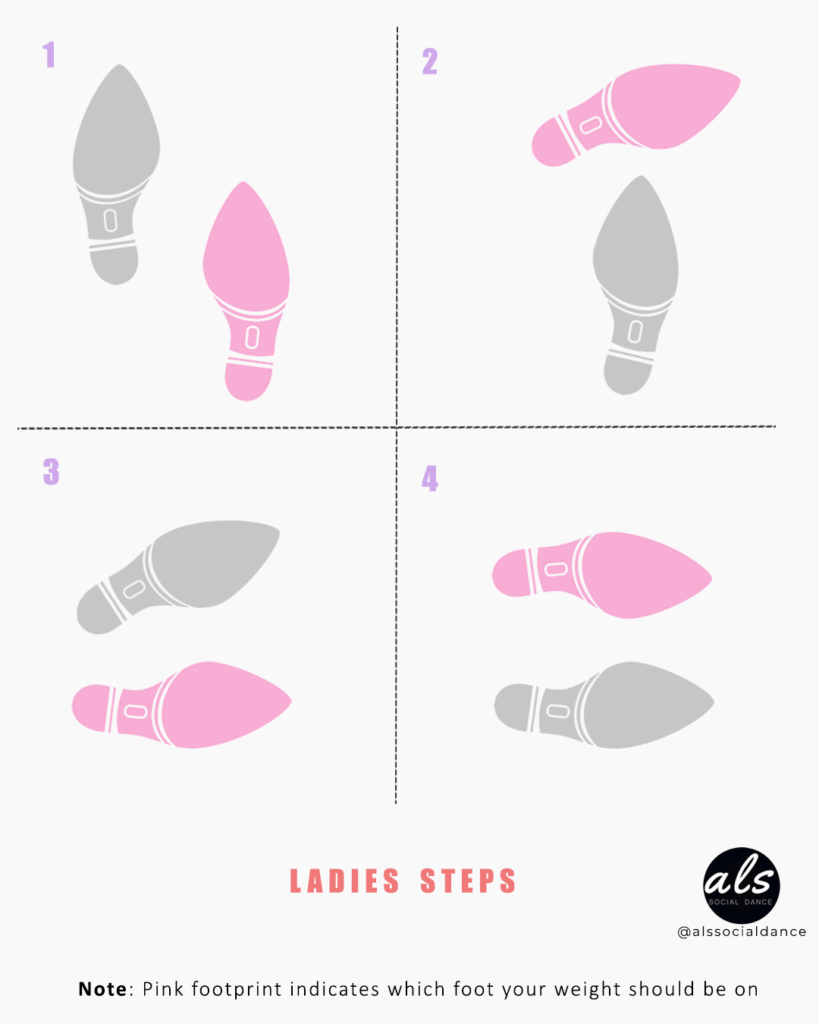
The lady starts with her right foot (RF). So, her 1st and 3rd count will be with her RF whereas the 2nd and 4th counts will be with her LF. Hence, using the same word association as in the together section above, we have the following
| 1 | 2 | 3 | 4 |
| Right Foot | Left Foot | Right Foot | Left Foot |
| Back | Rotate (90⁰ CW) | Together | Together |

Starting position: So as a woman, when starting off, your feet are together but your weight will be more on your LF, so that you have your RF pre-ready to move on count 1. Body angle wise, you’ll be face to face with the man, looking straight ahead at 12 o’clock from the woman’s POV (or 6 o’clock from the man’s POV)
Count 1: On count 1, you’ll move your RF back (about a foot back), leaving your LF where it was. This is the “back” from the word-association. Remember that both feet are on the ground, neither is hanging in the air, but at the same time, your entire body weight should be completely on the RF (so that the LF is free to move for the next step). In terms of your body angle, you’ll still be looking at 12 o’clock from the woman’s POV (or 6 o’clock from the man’s POV)
Count 2: Lift up your LF, but place It at 90 degrees CW i.e. so that it is pointing at 3 o’clock from the woman’s POV (or 9 o’clock from the man’s POV). Your RF will remain pointing at 12 o’clock from the woman’s POV. Your LF heel should be near the top of your LF’s big toe. In terms of your body angle, there is no hard or fast rule that you should be looking at 12 o’clock or 3 o’clock. Although it might sound difficult, it’s actually easy for the woman since you’ll still be facing the guy and will land up in the right spot since he controls your body movement via his hands. Also, your entire body weight should be completely on the LF (so that the RF is free to move for the next step).
Count 3: RF will now lift off and join together with the LF at 3 o’clock (from the woman’s POV). Remember, you would have lifted your RF into the air before bringing it down “together” with the LF (don’t try to simply drag it along the floor or rotate without lifting, you’ll end up taking a much shorter step compared to the man). Your entire body weight should be completely on the RF (so that the LF is free to move for the next step). In terms of your body angle, you’ll be face to face with your partner since that is where the man will place you.
Count 4: Your LF lifts into the air (about an inch or two) and then joins back again “together” in the same spot. You can think of this as a “replace” action, but the reason I prefer calling it “together” is that it gives me a chance to adjust my RF positioning should I need to, so feel free to adjust the positioning of the foot while placing it down such that it is “together” with the RF. Remember that both feet are on the ground, neither is hanging in the air, and your entire body weight should be completely on the LF. No change in position of the RF. At the end of count 4, the woman is facing her man and would have completed a rotation of 90 degrees, i.e. she would have rotated 90 degrees CW from her initial position at step 1. In other words, if the man finished his step at 3 o’clock, the lady would be facing him at 9 o’clock.😊
Hands:
Apart from using Resistance (which we learnt from the previous lesson), it’s essential that the man gives the correct hand indication as he is doing the leading and the woman will follow his lead. An incorrect lead will result in an incorrect positioning of the woman. So as a man, on count 2, pull your RH a bit towards you while pushing your LF a couple of inches forward. This contra motion of pulling one hand and pushing the other will automatically result in your partner getting the lead to rotate CW.
If you both have resistance. If there is lack of resistance, no matter how much you push or pull your partner, she won’t budge!