
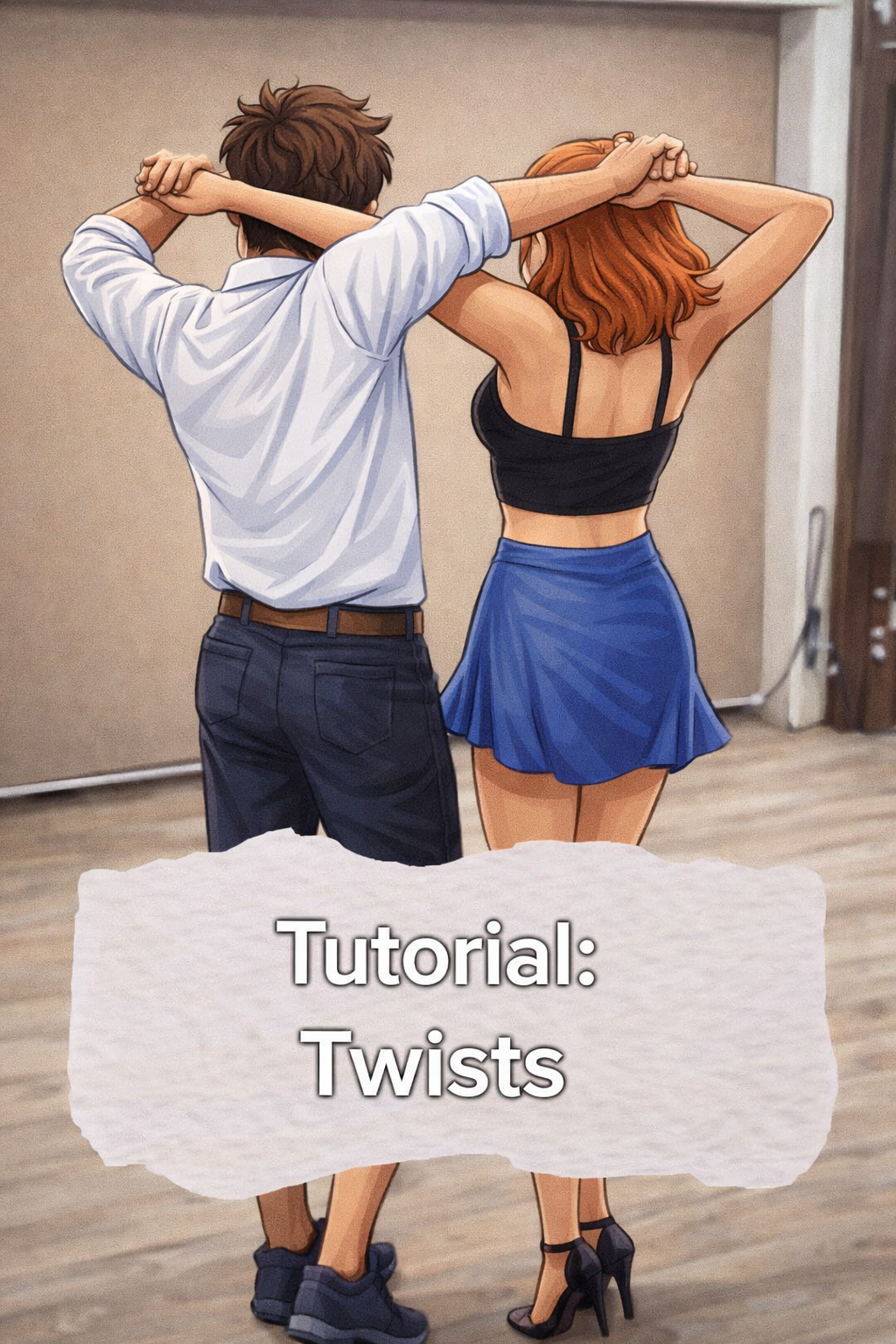
Among the many playful moves in jive, the Twist is one of those steps that always gets a reaction on the dance floor. It looks fun, slightly cheeky, and when done correctly it creates a really nice moment of connection between the leader and follower.
At first glance, the twist might look a little complicated because the hands interlock behind the neck. But once you understand the structure of the step and the timing, it becomes surprisingly easy to execute.
Let’s break it down.
Getting Into the Twist Position
The twist begins from a normal open hold position. As the leader, you will guide the follower so that both of you interlock hands and bring them behind the neck.
Here’s the important part to remember:
-
Your right hand should go behind the lady’s neck.
-
Your left hand should go behind your own neck.
This positioning allows the arms to interlock naturally while still maintaining control and comfort for both dancers.
Once the hands are placed behind the necks, the bodies remain facing each other and the frame stays relatively compact. This is not a move where you want your arms stretched far apart. Keep the connection relaxed but secure.
The Twisting Action
Once the arms are in position, the actual twisting movement begins.
Both partners start twisting their lower bodies slightly from side to side while maintaining the hand connection behind the neck. The movement should feel playful rather than forced. This twisting of the feet should be forward moving i.e the couple begins to twist around each other in a semicircle. This twisting motion is important because it keeps the step dynamic rather than simply walking around in a semicircle.
Think of it as a small rotating circle where both dancers are moving together rather than spinning independently.
The key here is to stay relaxed. The twist is meant to look light and fun, not stiff or mechanical.
Exiting the Twist
Every good move in jive should set you up for the next step, and the twist is excellent for transitions.
At the end of the twisting motion, the couple naturally slides out into a right-to-right hand connection. This position opens the door to many different possibilities.
Once you reach this right-to-right connection, you can easily transition into several other moves.
Some popular options include:
-
Hand on Shoulder Cuddle
-
Three Spins for the Lady
- Cuddle Walks
This is one of the reasons the twist is such a useful step—it connects nicely with many other patterns.
A Very Important Timing Tip
One critical detail that leaders must pay attention to is timing when placing the hand behind the lady’s neck.
If you are too slow with this placement, the follower’s natural momentum may already carry her forward. When that happens, the arm position becomes awkward and it can place unnecessary strain on her shoulder.
In some cases, this can even cause sharp discomfort or pain.
So the rule is simple:
Place your right hand behind the lady’s neck quickly and smoothly as the step begins.
When done correctly, the connection feels natural and comfortable.
If you are too slow with this placement, the follower’s natural momentum may already carry her forward. When that happens, the arm position becomes awkward and it can place unnecessary strain on her shoulder. In some cases, this can even cause sharp discomfort or pain.
A Nice Combination to Try
The twist works particularly well when combined with other spinning movements.
For example, you can:
-
Start with three spins for the lady, then transition immediately into the twist.
-
Or begin with the twist, exit into a right-to-right connection, and then launch straight into three spins.
Both combinations flow beautifully and add variety to your dancing.
Watch the Video Demonstration
To really understand how the twist works, it helps to see the movement visually.
I’ve attached a video demonstration below this article, where you can watch the exact hand placement, twisting motion, and exit into the right-to-right connection.
Once you see it in action, the step becomes much easier to learn and practise.
Final Thoughts
The twist is a fun and expressive step that adds personality to your jive dancing. With correct hand placement, relaxed movement, and proper timing, it becomes a great transition move that connects seamlessly to many other patterns.
Practise the mechanics slowly first, and once you feel comfortable, start adding it into your social dancing.
And most importantly—have fun with it. That’s what jive is all about. 💃🕺